Tech in Retail
AI Isn’t Replacing Retail. It’s Re-Imagining It.
The fear that AI will hollow out retail is the wrong frame. The brands winning right now are using it to deepen human connection, not replace it — and the gap between those who get this and those who don't is widening fast.

Zenul Jinwala
The wrong question is dominating the conversation
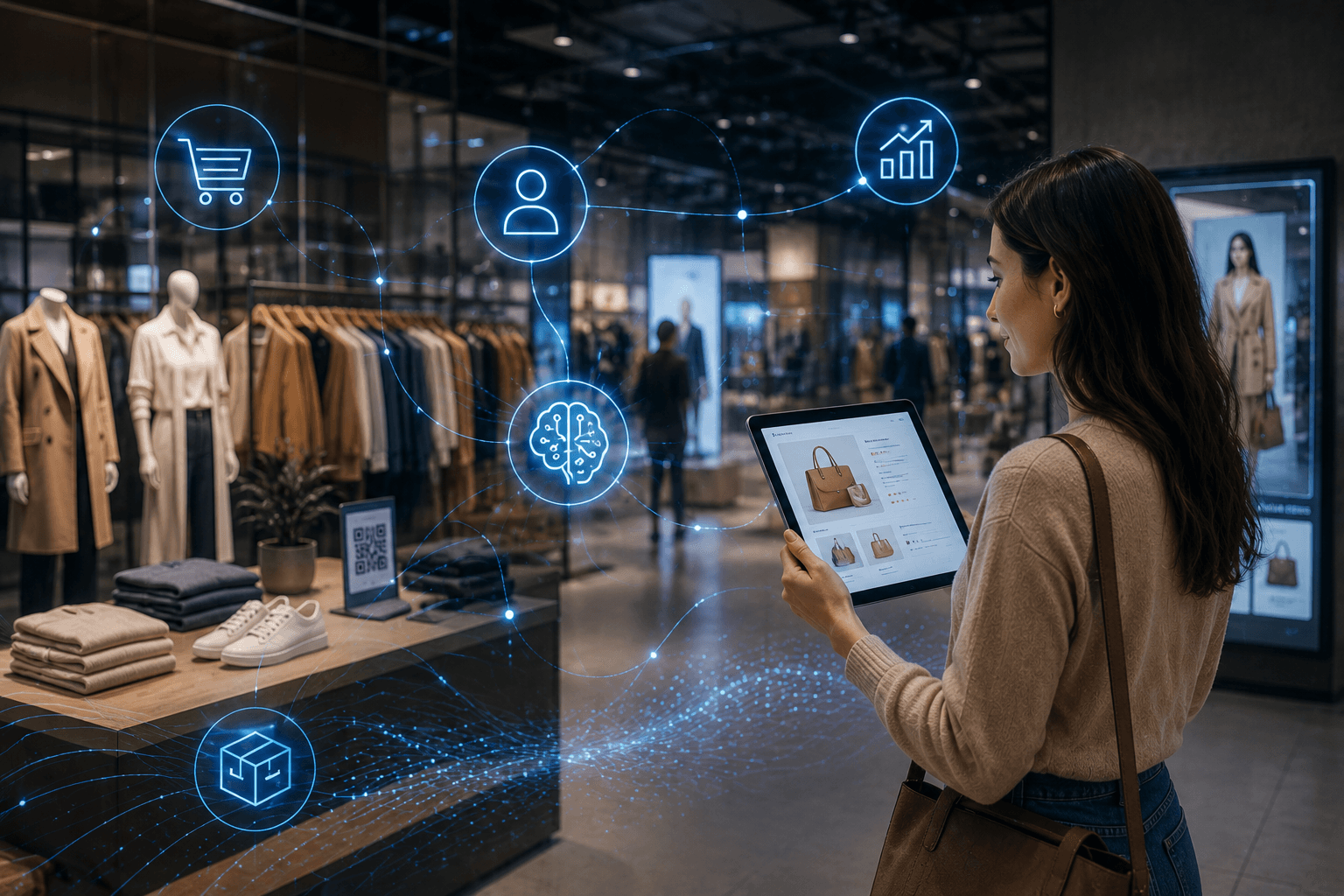
Walk into almost any retail boardroom today and you’ll hear a version of the same question: “How many roles will AI eliminate?” It’s the wrong question — and the brands still asking it are already falling behind the ones asking a better one: “How does AI help us do what humans can’t do alone?”
The narrative of replacement is seductive because it’s simple. Automation replaces cashiers. Chatbots replace service agents. Recommendation engines replace buyers. But this framing flattens a far more interesting and commercially consequential truth: in the hands of retail leaders who understand it, AI is not a cost-reduction tool. It is a capability expansion engine.
The stores, brands, and operators winning with AI in 2026 aren’t winning because they’ve reduced headcount. They’re winning because they’ve multiplied what their people, their inventory, and their customer relationships can do.
Fear vs. reality: what AI is actually doing on the shop floor
There’s a meaningful distinction between AI as a threat and AI as a tool — and most of the fear stems from conflating automation with intelligence. Automated checkouts reduce friction. They’ve existed for two decades. That’s not what’s happening now.
What’s happening now is generative AI that writes personalised product descriptions at scale. Agentic AI that autonomously reorders inventory when a weather pattern suggests a demand spike. Vision AI that flags planogram compliance in real time without a field visit. These aren’t replacements. They’re augmentations — they make the work of retail faster, sharper, and more responsive than any human team could manage without them.
“The question isn’t whether AI will change retail jobs. It already has. The question is whether leaders are steering that change — or reacting to it.“
Across Retail A:Rise’s community of operators and founders in India, the Middle East, and Southeast Asia, the most consistent signal we hear is this: AI is not replacing the retailer’s judgment. It’s giving that judgment better inputs, faster feedback, and wider reach.
The numbers that make the case
The AI retail market is not a pilot anymore
The global AI in retail market was valued at USD 9.36 billion in 2024 and is projected to grow at a CAGR of 34.1% through 2030, reaching over USD 54 billion. This is not speculative investment — it reflects production deployments at scale, from demand forecasting to loss prevention to dynamic pricing.
By the numbers
USD 54 billion
Projected size of the AI in retail market by 2030 — growing at 34.1% CAGR. Retailers investing now are not early adopters. They’re on time. Those waiting are late.
India: the scale-up story
India’s retail sector — now the world’s fourth-largest — is projected to reach USD 3.12 trillion by 2035, and AI is embedded in this growth story at every layer. From hyperlocal demand forecasting for kirana supply chains to AI-powered loyalty personalisation at Reliance Retail, the application of AI in Indian retail is uniquely diverse: it must work at luxury scale, mid-market scale, and mass-market scale simultaneously. No other market demands that range.
The Middle East: AI-native retail from the ground up
The GCC is building retail infrastructure in 2026 that didn’t exist five years ago — which means it’s being built AI-first. Majid Al Futtaim’s AI-powered customer engagement platforms, Noon’s logistics intelligence layer, and the Saudi Vision 2030 retail modernisation drive are not bolt-ons. They’re foundations. The region’s e-commerce segment is growing at a CAGR of 16.8% and AI is the architecture beneath it.
Exploring AI strategy for your retail brand? Talk to leaders already doing it.
Where it’s actually working
Hyper-personalisation at scale
Myntra’s AI-driven style recommendations now account for a significant share of its total conversions. Tata Neu’s unified intelligence layer — connecting BigBasket purchases to 1mg health data to Tata Cliq fashion behaviour — enables personalisation that no human CRM team could orchestrate across 100 million customers. Nykaa uses AI to tailor beauty recommendations based on skin type, regional climate, and browsing history simultaneously. These are not A/B tests. They are production systems serving tens of millions of shoppers daily.
Inventory intelligence and demand sensing
Perhaps the most commercially impactful application of AI in retail is one customers never see: the demand forecast. AI systems that read weather patterns, social media signals, local events, and real-time POS data to predict what a store needs — before the store knows it needs it — are reducing out-of-stock rates by 20–30% for retailers who’ve deployed them properly. In a margin-compressed industry, that is transformational.
Key insight
20–30% reduction
In out-of-stock rates reported by retailers deploying AI-powered demand sensing. For a mid-size retailer with INR 500 crore in annual revenue, this can represent tens of crores of recovered sales — annually.
The AI store associate
Verizon’s retail division has deployed what they call the “phygital brand ambassador” — associates equipped with real-time AI dashboards that surface a customer’s browsing history, purchase patterns, and product preferences before the conversation starts. Sephora’s Beauty Advisor tool gives in-store staff product knowledge that would take years to accumulate organically. The best retail associates today are not competing with AI — they’re using it to become categorically better than associates from five years ago.
Loss prevention and operational integrity
Computer vision AI that monitors shelf compliance, detects shrinkage patterns, and flags planogram deviations in real time is quietly saving retailers hundreds of millions of dollars globally. Walmart’s camera-based AI systems monitor freshness in produce sections. Aeon in Japan uses vision AI to track basket composition and adjust staffing dynamically. These are not futuristic experiments — they are live, at scale, generating measurable ROI.
The three strategic shifts AI requires of retail leaders
1. From data collection to data activation
Most retailers are drowning in data and starved of insight. The first shift AI demands is moving from passive data collection to active data activation — using what you already know about customers to make decisions in real time, not quarterly reports. This requires integrating POS, CRM, e-commerce, and loyalty data into a unified view. The technology to do this exists. The organisational willingness to prioritise it is what separates the leaders from the laggards.
2. From channel management to journey orchestration
AI enables retailers to stop thinking about channels — online, in-store, app, social — and start thinking about journeys. A customer who discovers a product on Instagram, researches it via ChatGPT, tries it in-store, and buys it on the app is one customer on one journey. AI is the connective tissue that makes that journey coherent and personal at every touchpoint. Retailers still managing channels as silos are building experiences that feel broken to customers who live between them.
3. From efficiency to experience
The biggest mistake retail leaders make with AI is routing it entirely to cost reduction. The most enduring competitive advantage comes from routing it toward experience creation — making every customer interaction feel more considered, more relevant, and more human than it would have been without AI. Efficiency gains fund the investment. Experience differentiation is the moat.
“AI that only cuts costs is a commodity. AI that creates experiences is a competitive advantage.“
What leaders get wrong
The most common failure mode we observe in retail AI deployments is not technical — it’s strategic. Leaders treat AI as a project rather than a capability. They fund a pilot, declare success on a narrow metric, then move on. The retailers winning with AI are treating it as permanent infrastructure — iterating continuously, expanding use cases, and building internal teams who understand it deeply.
The second failure mode is deploying AI without solving data quality first. An AI recommendation engine is only as good as the data it trains on. Retailers with fragmented customer data, inconsistent SKU tagging, and siloed loyalty systems will get mediocre outputs regardless of how sophisticated the model is. The technology is the last 20%. The data infrastructure is the first 80%.
By the numbers
Only 18% of retailers
in emerging markets report having a unified customer data platform capable of powering real-time AI personalisation. The vast majority are investing in AI models on top of data foundations that aren’t ready for them.
The road ahead
By 2027, the retailers who invested in AI infrastructure between 2024 and 2026 will hold structural advantages that late movers cannot easily replicate. Customer data compounds. Model performance improves with more training data. Operational muscle memory for AI-assisted decision-making takes time to build. The brands who are doing this work now are not just gaining short-term efficiency — they’re accumulating long-term defensibility.
The retailers who will define the next decade of commerce are not the ones building the best AI model. They are the ones building the best relationship between AI capability and human judgment — and deploying that relationship at every customer touchpoint.
“The future of retail isn’t human or machine. It’s human through machine — and the best retailers are already living there.“
The Retail A:Rise perspective
At Retail A:Rise, this is the conversation at the centre of every roundtable — from Bengaluru to Dubai to Singapore. Our community of founders, operators, and innovators is not debating whether to use AI. They’re sharing what’s working, what failed, and what they’d do differently. The answers are rarely about technology. They’re almost always about leadership, data readiness, and organisational willingness to change.
The question is not whether your business will be transformed by AI. It’s whether you’ll be the one doing the transforming — or the one being transformed.
Join the Tribe
Want to explore what this looks like for your brand?
Connect with the leaders building it right now — at our next roundtable in your region.
Stay in the loop
Get the next dispatch in your inbox.
Curated takes on retail innovation across India, MENA and SEA — every two weeks. No noise.