Retail Innovation
How GIVA Jewellery Uses Data, AI & Personalization to Build Digital Trust
How do digital-first brands build customer trust without face-to-face interactions? This episode explores how GIVA uses AI, data, and personalization to create meaningful shopping experiences.

Nishit Kathlana
Introduction & Episode Overview
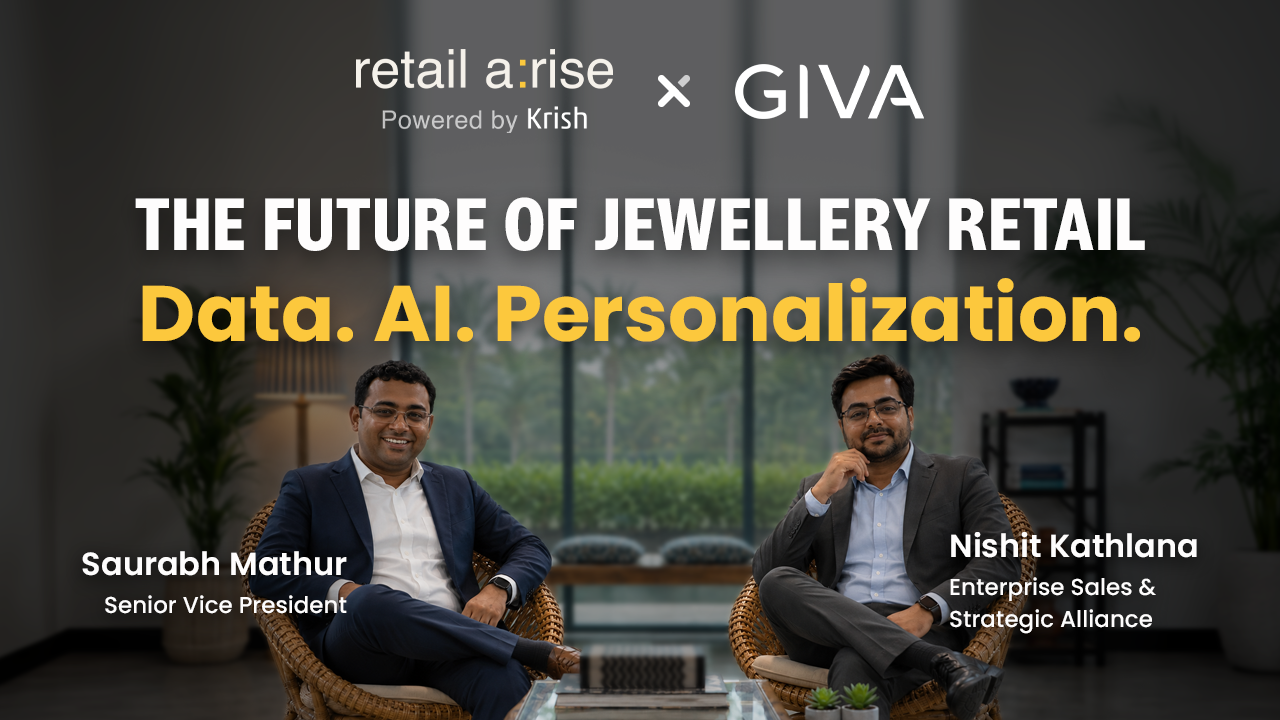
Nishit: Welcome to another episode of the Retail Arise podcast. Retail Arise is a community built for retail leaders who exchange ideas, share experiences, and discuss what’s actually shaping the future of retail. Today we’re joined by Saurabh Mathur, Vice President at GIVA Jewellery, who has played a key role in scaling GIVA into one of India’s most loved digital-first jewellery brands.
Jewellery has traditionally been sold through relationships, trust, and personal recommendations built inside physical stores. As more customers begin their buying journey online, how do brands recreate that same sense of trust in a digital-first world? That’s where today’s conversation starts, and it takes us through customer intent data, personalization at scale, the line between AI and human judgment, and what happens when AI agents start shopping on a customer’s behalf.
Building Trust in a Digital-First Jewellery Brand
Nishit: Jewellery has been traditionally built on relationships, trust, and personal recommendations. Now that more customers begin their buying journey online, how do you recreate that same sense of trust in a digital-first world?
Saurabh Mathur: Jewellery is an industry that has always relied heavily on trust and relationships. It’s been dominated by offline stores. Customers wanted to hold the product, see the hallmarks, and get a personal recommendation from the sales staff. That human factor was always what provided the trust.
I don’t think that trust has changed. The medium has. A modern brand can’t afford to be offline-only anymore; we need an omnichannel approach where the online presence is just as important. What has changed is how customers build that relationship with the brand. Today, customers expect detailed product images, authentic reviews, easy returns, certifications, secure payments, fast delivery, and responsive customer support. All of that together builds the trust factor.
A customer might find GIVA on Instagram, come to our website, and then finally purchase in an offline store. So the one umbrella factor that matters most is consistency. The product feel, the features, the messaging all need to be the same across every channel. That consistency is what earns trust today.
Understanding Customer Intent Through Data Signals
Nishit: Once customers start interacting digitally, every click and search creates a valuable signal. Can data actually tell you whether someone is shopping for themselves, preparing for a wedding, or buying a gift? How accurately can you understand buying intent today?
Saurabh Mathur: Not with 100% certainty we’re not there yet. But there are so many browsing and purchase signals through the customer journey that we get a very realistic idea of intent. A customer browsing our Valentine’s collection behaves very differently from someone searching for silver mangalsutras or bridal collections.
Combine that with frequency, browsing depth, wishlist behavior, delivery addresses, occasion campaigns, and previous purchases. None of these signals in isolation tell you much, but together, intent becomes surprisingly visible. We’re able to understand customers far beyond the general demographic data we used to rely on age, geography, gender. Today, thanks to the volume of data available, we get a much clearer picture.
Personalization at Scale: From Segments to Micro-Segments
Nishit: Understanding intent is one thing. Turning those signals into personalized experiences for millions of customers, while still making every interaction feel unique, is a bigger challenge. How does GIVA tackle this?
Saurabh Mathur: We can’t just be selling a product. We’re here to build relationships and the stories each customer brings. Understanding the customer is only half the work; the other half is making them feel understood. Today, personalization has become a luxury. It’s about relevance, showing the right product at the right moment through the right channel with the right message.
The difference between two customers in the same segment can be so huge that it becomes a challenge to create a genuinely premium, personalized experience for each of them. Once we identify the intent signals behind each customer through CRM, through the UI/UX on the website or app, that journey keeps adjusting to their needs. If we get a signal that someone is looking for a gift for their wife, girlfriend, or sister, we show them a smaller, curated catalog of best-selling gifting products. That’s where personalization comes into play for GIVA.
Right now, because of the limitations of manual work, we can only segment customers into 10 or 15 buckets, but with the volume of customers coming to our website every month, force-fitting them into 15 segments is practically impossible. With AI, we can create very sharp, distinctive segments not limited to 10, 15, or even 100. Taken to the extreme, each customer can be their own segment. AI incorporates all of those signals into one distinctive profile and creates a predictive journey automatically, without anyone manually building thousands of journeys by hand.
Why Personalization Is Becoming the New Luxury
Nishit: Luxury has always been about making customers feel special. Do you think personalization is becoming the new definition of luxury?
Saurabh Mathur: Definitely. Today, luxury doesn’t come from the product alone, or how the website looks, or how well the store is designed. It goes far beyond that, luxury today derives its value from the customer feeling that the brand knows them well and is putting in the effort to solve for their specific needs. Once a customer feels that, their trust and perception of the brand increases exponentially, and that’s where the premium factor comes in.
They don’t want to feel like they’re in a flea market, bombarded with a blanket campaign. It’s the same principle that used to define the offline jewellery experience. A salesperson understanding needs and recommending accordingly. A store might carry two thousand designs, but a customer’s need matches only a subsection of them. The ability to solve that to make the customer’s life easy is where premiumization exists today.
Convenience: The Overlooked Personalization Enabler
Nishit: Alongside personalization, data, and trust, I’d add that convenience plays a key role too. It’s why quick commerce has grown so fast. Customers get the same luxury sitting at home instead of going out.
Saurabh Mathur: Bang on. Even in quick commerce, there was a need to solve for quick delivery and instant gratification. Once a business starts solving for the customer on that dimension, it completely changes the landscape.
Where AI Adds Value and Where Human Judgment Wins
Nishit: Personalization and convenience at scale aren’t possible without technology. Where do you think AI adds the most value today, and where should human creativity and judgment remain non-negotiable?
Saurabh Mathur: I heard a line once: AI removes repetitive work, while humans continue creating emotional work. That’s the genuine distinction. We use AI to accelerate things and reduce redundancy, but it can never replace judgment. Human intelligence still plays a very big role.
AI is becoming an incredible brainstorming partner. I can create hundreds or thousands of creatives in one go, but figuring out which of those creatives will actually work is where the human advantage comes in. The same applies to segmentation: because of the limitations of manual and non-AI technology, we’ve been boxing customers into 10 or 15 segments. That’s practically impossible to do accurately at scale. With AI, we can create very sharp, individual-level segments and build predictive journeys for each of them automatically. A customer can even sit across multiple campaigns depending on their signals, and AI can mix and merge those journeys into a personalized message.
Agentic Commerce: When AI Chooses (and Buys) the Jewellery
Nishit: AI is already helping brands personalize experiences, but we’re moving toward a future where AI assistants could recommend or even make purchases on behalf of customers. If AI starts choosing jewellery for customers, what becomes the real competitive advantage for brands?
Saurabh Mathur: In the traditional world, the winner was whoever had the best branding story, the best product, or ultimately the lowest price. But in a future shaped by AI, the winner will be the brand with the richest product-to-customer understanding and the ability to map products against a customer’s exact requirement.
We already have systems that can predict something like a repeat purchase, say a skincare product that’s about to run out and prompt a reorder. But the next stage is differentiating between two different customers: one who wants to buy the same product again, and one who’s more experimental and might want to try something new. Push that further, and AI doesn’t just recommend. It makes the purchase decision on the customer’s behalf, the way it might manage a kitchen pantry, continuously deciding whether a product is needed and buying it accordingly. Some customers will still want to stay fully involved in their purchase journey, and that’s fine. We’ll build a different journey for them. But for the majority of customers, I think we’ll need to move in this direction.
Nishit: That also opens up an upsell strategy if someone reorders the same product every time, the brand can introduce customizations or new products and move them further along the customer journey.
Leadership Skills for the AI-Driven Retail Era
Nishit: Technology is changing quickly, but customer expectations are changing even faster, which means leadership has to evolve too. There’s real friction among brands trying to figure out how fast to adopt AI. What are your thoughts?
Saurabh Mathur: AI isn’t here to replace humans. Its purpose is to make human work easier. With that in mind, I think future leaders need three capabilities: customer empathy, to understand and solve for what the customer is facing; data literacy, because data today is as valuable as gold, and you need to know how to read it and turn it into action; and technological curiosity the best decisions happen when intuition starts the conversation and a layer of data justifies the hypothesis behind the change.
There’s genuine friction across the industry as leaders figure out how much AI to adopt and how fast. Those are valid doubts, but there shouldn’t be any hesitation about at least understanding and testing what AI can do. Once leaders build that understanding of AI and data, things get a lot easier.
The Biggest Personalization Mistake Brands Still Make
Nishit: What’s one major shift in retail, customer experience, or marketing that most brands are still underestimating?
Saurabh Mathur: A lot of brands treat personalization as purely algorithmic, running every new user through the same fixed bucket, for example. That’s the biggest mistake. For a brand like GIVA, where emotion drives a lot of purchase decisions, you can’t sell effectively by putting every customer into one algorithm. It’s about understanding people. What makes them come to our website, our store, or even our Instagram page.
And because of the number of data points and channels involved, having a truly unified approach to data is going to be critical. That’s an area every brand, not just GIVA, needs to invest in.
Rapid-Fire Round with Saurabh Mathur
Nishit: Let’s close with a quick rapid-fire round. One word or one sentence each.
Most overrated KPI in retail marketing? ROAS, when looked at in isolation.
If you could have only one source of data, what would it be? A single, unified internal database pulling together every marketing and revenue channel.
One AI use case that’s currently overhyped? AI chatbots. A good use case, but AI and data are far more than that, it’s just the beginning.
One MarTech capability that will become essential in the next three years? Micro-segmentation, built on unified data, enabling truly personalized journeys for each individual customer.
Wrap-Up & Key Takeaways
Nishit: What I’m taking away from this conversation: the future of retail isn’t becoming less human because of AI. The brands that thrive will be the ones that use data to understand people better, personalize more effectively, and let technology remove friction from customers’ lives.
Saurabh, on the headline he hopes to read in 2030: “I’d love it if the headline says GIVA becomes the world’s most loved jewellery brand by making technology feel deeply human. We want to use technology to our advantage, but to understand customers better and bring them closer to the brand, not to replace that human closeness.”
Thank You & What’s Coming Next
Nishit: Thank you, Saurabh, for sharing the journey behind GIVA’s approach to customer experience, data, and innovation. And thank you to our listeners for tuning in. We’ll see you soon in the next episode of Retail Arise.
Join the Tribe
Want to explore what this looks like for your brand?
Connect with the leaders building it right now — at our next roundtable in your region.
Stay in the loop
Get the next dispatch in your inbox.
Curated takes on retail innovation across India, MENA and SEA — every two weeks. No noise.