Tech in Retail
How GIVA Jewellery Is Turning Data and AI Into the New Language of Trust
Jewellery has always been sold on trust. For decades, that trust lived inside a physical store in the weight of a piece in your hand, the credibility of a hallmark, and the word of a salesperson who knew the customer by name.

Zenul Jinwala
The wrong question is dominating the conversation
Jewellery has always been sold on trust. For decades, that trust lived inside a physical store in the weight of a piece in your hand, the credibility of a hallmark, and the word of a salesperson who knew the customer by name.
So what happens when that same category goes digital-first?
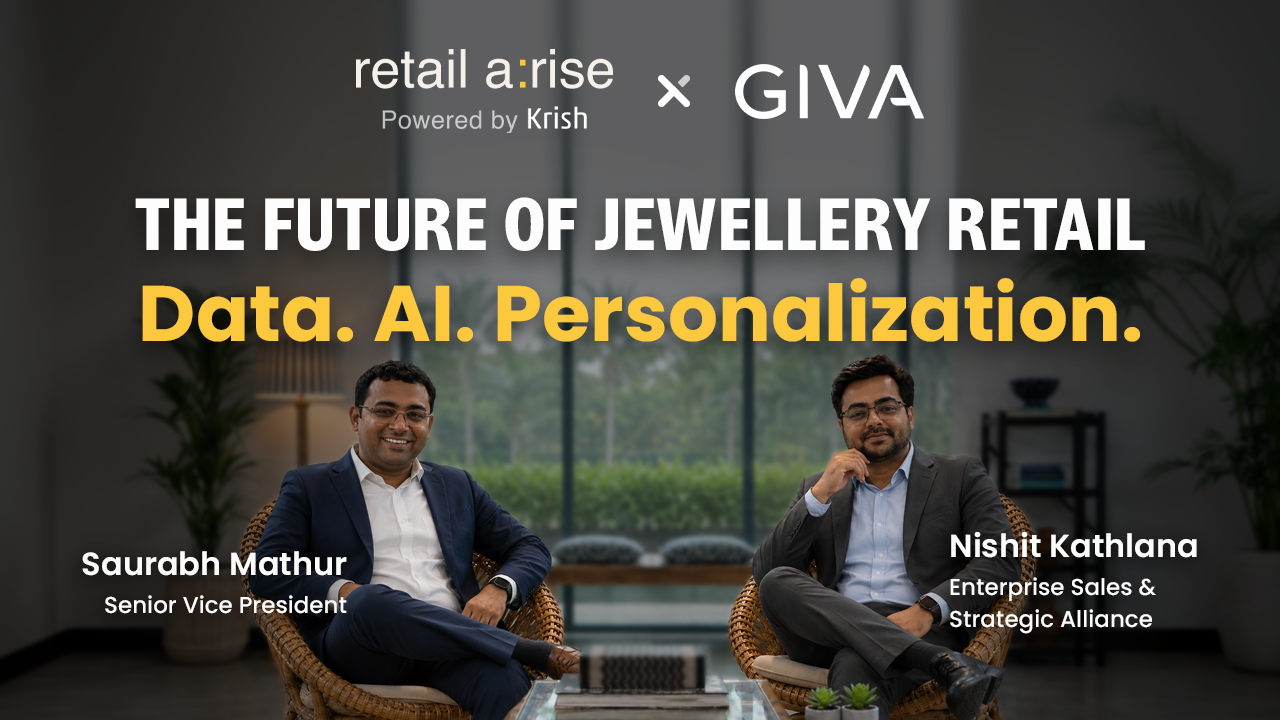
We put that question to Saurabh, Vice President at GIVA Jewellery, one of India’s fastest-growing digital-first jewellery brands, as part of the Retail Arise podcast series by Krish TechnoLabs. Over the course of the conversation, Mathur laid out a detailed view of how GIVA uses first-party data, behavioral intelligence, and AI to recreate, and in some ways improve upon, the trust that once belonged exclusively to the neighbourhood jeweller.
This article distills that conversation into a strategic playbook for retail, ecommerce, and MarTech leaders navigating the same shift: from demographics to behavior, from campaigns to relationships, and from personalization to autonomous, AI-driven commerce.
Building a Modern Jewellery Brand for the Digital-First Consumer
Trust Hasn’t Disappeared. The Medium Has.
Mathur’s central argument is simple but easy to miss: jewellery buyers haven’t stopped needing trust, they’ve just stopped getting it from a single, physical source.
Where trust once came from seeing a hallmark in person or hearing a recommendation from a familiar salesperson, it now comes from a different set of signals entirely, detailed product photography, verified customer reviews, transparent certifications, secure payment options, dependable delivery timelines, and responsive support. None of these individually replace the in-store experience. Together, they rebuild it in digital form.
There’s also a consistency requirement that didn’t exist in the single-channel world. A customer might discover a brand on Instagram, research it on the website, and eventually complete a purchase in a physical store. If the messaging, product experience, or tone shifts across any of those touchpoints, trust erodes. Omnichannel consistency isn’t a nice-to-have anymore it’s the foundation trust is built on.
From Occasion-Driven to Lifestyle-Driven Buying
The other shift Mathur pointed to is in why people buy jewellery in the first place. It’s no longer confined to weddings, festivals, or milestone occasions. Today’s buyers purchase to mark a promotion, celebrate a friendship, commemorate a vacation, or simply reward themselves no occasion required.
That matters strategically because every purchase now carries a personal narrative behind it. The brand’s role isn’t just to sell a product; it’s to become part of that customer’s story. And understanding that story at scale is only possible with data.
Understanding Customer Intent Through Data
Behavior Beats Demographics
For years, retail segmentation leaned on age, gender, and geography. Mathur was direct about why that model is losing relevance: two 28-year-old women can have completely different buying journeys, shaped by entirely different needs, occasions, and price sensitivities.
Behavioral signals tell a far richer story:
- Browsing depth and frequency
- Wishlist activity
- Delivery address patterns
- Response to occasion-specific campaigns
- Purchase history and repeat-buy cycles
No single signal is conclusive on its own. A customer browsing an engagement ring collection during Valentine’s week behaves very differently from one searching bridal mangalsutra sets but it’s the combination of signals that makes intent visible with real confidence.
| Traditional Segmentation | Behavior-Led Segmentation |
| Age, gender, geography | Browsing depth, wishlist activity, purchase cadence |
| Broad, static buckets (10–15 segments) | Dynamic, near-individual segments |
| Assumes similar customers behave similarly | Recognizes two similar customers can have entirely different journeys |
| Manually built campaigns | AI-generated, predictive journeys |
Why First-Party Data Is the Real Long-Term Asset
As third-party cookies phase out and platform algorithms keep shifting, Mathur’s view is that the only durable advantage left is a brand’s own, owned relationship with its customers. That’s the case for investing seriously in first-party data infrastructure unified customer profiles that don’t disappear when a platform changes its rules.
Personalization at Scale: Making Every Customer Feel Special
Personalization Is the New Definition of Luxury
Asked whether personalization has become the new luxury, Mathur didn’t hedge: it already has. In his view, luxury today isn’t defined by exclusivity or store ambience alone it’s defined by relevance. Showing the right product, at the right moment, through the right channel, with the right message,
feelspremium in a way generic outreach never will.
Customers don’t experience a brand in channels they experience it as one continuous relationship, whether that starts on Instagram, continues on the website, and closes in-store.
Convenience Is Personalization’s Quiet Partner
One point that came up directly in the conversation and deserves more attention than it usually gets is convenience. The same forces driving adoption of quick commerce (instant gratification, frictionless delivery) apply just as much to jewellery. Personalization gets a customer to the right product faster; convenience makes sure the rest of the journey doesn’t undo that advantage.
The Segmentation Ceiling and How AI Removes It
Here’s where the conversation moved from philosophy to mechanics. Without AI, most brands are limited to somewhere between 10 and 15 broad customer segments simply because building and managing more than that manually isn’t feasible. But real customer bases don’t sort neatly into 15 buckets. Most customers sit somewhere between segments, and force-fitting them into the nearest bucket is, in Mathur’s words, one of the biggest mistakes brands make.
AI removes that ceiling. Instead of 15 segments, brands can move toward micro-segmentation in the extreme case, a segment of one. AI doesn’t just help sort customers into finer segments; it can generate and manage the predictive journeys for each of those segments automatically, at a scale no marketing team could replicate manually.
Where AI Adds Value and Where Human Judgment Still Wins
Mathur summarized the AI/human divide with a line worth remembering:
AI removes repetitive work; humans create emotional work.
In practice, that plays out as:
- AI’s role: generating large volumes of creative and content variations, surfacing product recommendations, building predictive customer journeys, and identifying micro-segments at scale.
- Human’s role: deciding which of those hundred AI-generated ideas actually deserves to go live. Judgment, taste, and emotional resonance remain firmly human territory.
From Chatbots to Advisors
Conversational commerce came up as a specific area of overreach. Mathur was candid that AI chatbots are currently one of the most overhyped use cases in the industry useful, but a small fraction of what AI can actually do for a brand. The more meaningful shift, in his view, is from chatbots that answer questions to advisors that build confidence.
The distinction matters: a customer asking for “a birthday gift under ₹4,000 for my sister” doesn’t want a filtered list they want a recommendation they can trust, the way a knowledgeable in-store salesperson would give one.
Agentic Commerce: When AI Becomes the Shopper
This is where the conversation moved furthest into the future and where Mathur’s thinking has direct implications for how ecommerce brands should structure their data and product content today.
Push the previous idea one step further: instead of AI recommending a product, AI selects and buys it on the customer’s behalf. Some of this is already happening in low-stakes categories (a predictive nudge to reorder a consumable, for instance). The bigger shift is when AI starts making the final call on higher-consideration purchases like jewellery while still leaving room for customers who want to stay fully involved in their own purchase journey.
The New Competitive Advantage
If an AI agent is the one selecting a product, the old competitive levers lowest price, best branding matter less. What matters instead is
the richness of a brand’s product-to-customer understanding
: how precisely a brand can map its inventory to a specific customer’s actual need, not just their segment.
That has a direct implication for how brands should be investing right now: structured product data, clear trust signals, and consistent customer satisfaction become the new inputs AI systems will weigh the equivalent of optimizing for an AI recommendation engine the same way brands optimize for Google today.
The Future Retail Leader: Balancing Brand, Data and Technology
Mathur named three capabilities he believes future retail leaders need to build, in this order:
- Customer empathy understanding what the customer is actually trying to solve for.
- Data literacy the ability to read data, interpret it correctly, and turn it into an actionable decision.
- Technological curiosity a willingness to test what AI can do rather than wait until it’s proven everywhere else.
His framing of decision-making is a useful mental model on its own:
intuition starts the conversation, and data finishes it.
Leaders don’t need to choose between gut instinct and analytics the two are meant to work in sequence.
The Biggest Underestimated Shift
Asked what most brands are still underestimating, Mathur pointed back to the segmentation ceiling: brands assume personalization means sorting customers into a fixed number of algorithmic buckets. For an emotionally-driven category like jewellery, that’s a mismatch. The brands that will pull ahead are the ones that treat personalization as understanding individual people, not managing segments backed by a genuinely unified view of customer data across every channel.
Rapid-Fire Insights From GIVA’s VP
- Most overrated KPI in retail marketing: Return on ad spend (ROAS), when viewed in isolation.
- If you could have only one source of data: A single, unified, internally-owned customer database across every channel.
- Most overhyped AI use case: AI chatbots valuable, but only a small slice of what AI can deliver.
- MarTech capability to watch in the next three years: Micro-segmentation, built on unified data, that enables genuinely individualized customer journeys.
Key Takeaways
- Trust in jewellery retail hasn’t disappeared it has migrated to transparency, consistency, and cross-channel experience.
- Behavioral signals (browsing, wishlist activity, purchase cadence) now outperform demographics as predictors of intent.
- First-party, unified customer data is the most durable competitive asset as cookies and platforms keep shifting.
- Personalization is increasingly synonymous with luxury relevance is the new premium.
- AI’s real value lies in scaling micro-segmentation and predictive journeys beyond the 10–15 segment ceiling of manual marketing.
- Human judgment remains essential for deciding which AI-generated ideas are worth pursuing.
- Agentic commerce will reward brands with the richest structured product-to-customer understanding, not just the lowest price or the strongest brand story.
- Future retail leaders need customer empathy, data literacy, and technological curiosity in that order.
FAQs
Q: How is GIVA Jewellery using AI in customer experience?A: GIVA uses AI to move beyond broad customer segments toward micro-segmentation, generate predictive customer journeys, accelerate content and creative production, and support product recommendations while keeping final creative and purchase-related judgment calls with human teams.
Q: Can data really tell if someone is buying jewellery for themselves or as a gift?A: Not with complete certainty, but combining multiple signals browsing behavior, wishlist activity, delivery address, and campaign response makes buying intent visible with a high degree of confidence.
Q: Why are demographics becoming less useful for retail personalization?A: Two customers with identical demographic profiles can have completely different buying journeys. Behavioral data captures actual intent and preference far more precisely than age, gender, or location alone.
Q: What is agentic commerce and how will it affect jewellery brands?A: Agentic commerce refers to AI agents that don’t just recommend products but make purchase decisions on a customer’s behalf. For jewellery brands, this shifts competitive advantage away from price and branding alone, toward how well structured and trustworthy a brand’s product data and customer understanding are.
Q: Is AI going to replace human roles in retail marketing?A: No the view shared in this conversation is that AI removes repetitive work while humans continue to handle emotional and judgment-based decisions, such as choosing which AI-generated creative or recommendation is actually right for the brand.
Q: What’s the most common mistake brands make with personalization?A: Treating personalization as sorting customers into a fixed set of algorithmic segments, rather than understanding each customer as an individual with a unique context and need.
Q: What skills do retail leaders need for an AI-driven future?A: Three, in combination: customer empathy, data literacy, and technological curiosity with intuition initiating decisions and data validating them.
Q: What should ecommerce brands start doing today to prepare for AI-led shopping?A: Invest in unified, first-party customer data and structured, detailed product information the same inputs AI recommendation and shopping agents will rely on to make decisions on a customer’s behalf.
Conclusion
The conversation with Saurabh makes one thing clear: the fundamentals of jewellery retail trust, relevance, relationship haven’t changed. What’s changed is the infrastructure required to deliver them at scale. Data replaces the salesperson’s memory. AI replaces the manual work of building thousands of individual customer journeys. And as agentic commerce moves from concept to reality, the brands that win won’t be the loudest or the cheapest they’ll be the ones with the deepest, most structured understanding of their customers and their products.
For retail, ecommerce, and MarTech leaders outside the jewellery category, the playbook translates directly: unify your data, move past demographic segmentation, let AI handle scale while humans handle judgment, and start preparing your product data for an AI-mediated shopping future that’s closer than it looks.
Building a first-party data strategy or preparing your product catalog for AI-driven and agentic commerce? Krish TechnoLabs helps retail and ecommerce brands design the MarTech, CDP, and personalization infrastructure needed to compete in this next phase of retail.Get in touch with our team to assess where your brand stands today.
Join the Tribe
Want to explore what this looks like for your brand?
Connect with the leaders building it right now — at our next roundtable in your region.
Stay in the loop
Get the next dispatch in your inbox.
Curated takes on retail innovation across India, MENA and SEA — every two weeks. No noise.